This Friday, SpaceX becomes a public company in what is set to be the largest SpaceX IPO in recorded market history. Behind the headline valuation sits a more interesting question for investors: is this a rocket company, an AI company, or a story that has already priced in a future that has not yet arrived?
By The Investment Strategy Desk

Pricing after market close on Thursday 11 June. First trading day Friday 12 June.
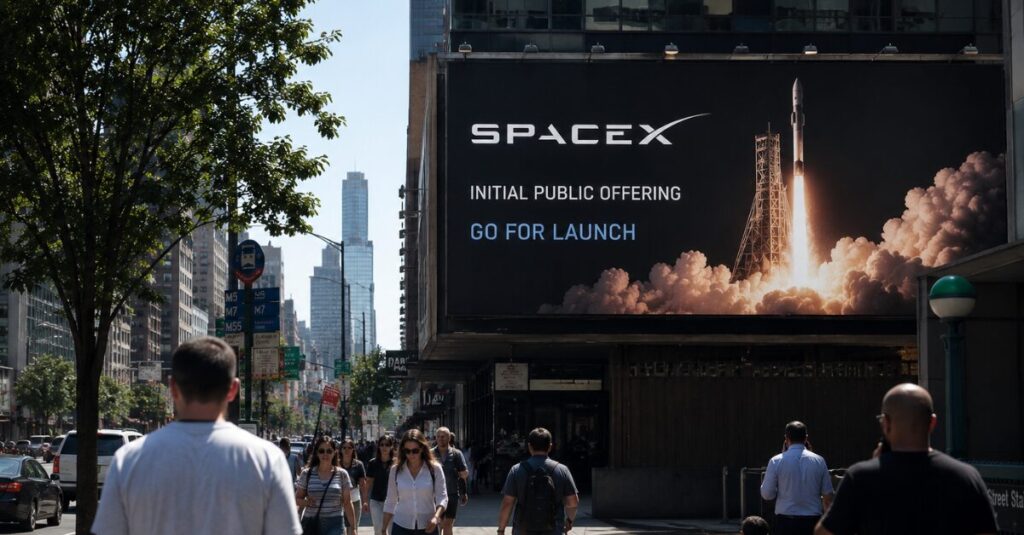
After more than two decades as one of the most valuable private companies on earth, SpaceX is finally coming to the public market. The company is expected to price on Thursday 11 June and begin trading on the Nasdaq on Friday 12 June under the ticker SPCX, at an offer price of $135 a share. At that level the business is valued at roughly $1.75 trillion and is raising in the region of $75 billion – comfortably the largest SpaceX IPO and initial public offering in stock market history, eclipsing Saudi Aramco’s $29 billion debut in 2019.
The demand has been extraordinary. The deal is reported to be heavily oversubscribed, the bankers have spent recent weeks courting wealthy clients, and a dedicated event for around 1,500 retail investors is planned ahead of pricing. Yet only about 3% of the company is being floated – a deliberately thin slice that concentrates demand and tells you a great deal about why the price is where it is.
Background: From Reusable Rockets to a Trillion-Dollar Platform
SpaceX was founded by Elon Musk in 2002 with the then-ambitious goal of making spaceflight cheap enough to matter. The breakthrough was reusability: the Falcon 9 rocket, which lands and flies again, collapsed the cost of reaching orbit and turned launch into a recurring business. From there came the Dragon capsule, NASA contracts including a central role in the return-to-the-Moon programme, the giant Starship vehicle, and – most importantly for the SpaceX IPO thesis – Starlink.
Starlink is the satellite-broadband network that now serves tens of millions of subscribers worldwide. It is the cash engine of the group, and the part of the business public investors understand most easily. The valuation, however, has climbed far beyond what launch and broadband alone can explain.
An employee share sale earlier this cycle priced the company around $800 billion. A February 2026 merger that folded in Musk’s AI venture, xAI, valued the combined entity at about $1.25 trillion. The IPO now asks the market for $1.75 trillion. Each step has added a layer of expectation about what comes next.
Valuation: Is the SpaceX IPO Overvalued?
The honest answer is that on almost every conventional measure, yes – and the people raising the alarm are not fringe voices.
Independent valuation work lands well below the offer price. Morningstar’s discounted-cash-flow estimate puts fair value near $63 a share, roughly half the IPO level, and the firm has been direct that investors may find better entry points after listing. NYU’s Aswath Damodaran, widely regarded as the dean of valuation, is more generous at roughly $100 a share – still below the deal price. At $135, the company is being priced at something like 90 to 100 times sales, which ranks among the most expensive listings ever attempted

So why might the SpaceX IPO price hold – or even rise – in the early days? Because in the short term, value and price are not the same thing. A 3% float means real scarcity. Appetite for anything labelled AI infrastructure is intense. And a company this size could be fast-tracked into major indices such as the Nasdaq 100, pulling in passive money that has to buy regardless of valuation. Some analysts who freely call the stock expensive still expect it to climb once trading opens, simply because demand swamps the available shares.
The Thesis: Why the SpaceX IPO Is Really an AI Story
The reason the SpaceX IPO price has detached from rockets is that, since absorbing xAI, SpaceX is increasingly sold to investors as an artificial-intelligence company that happens to launch rockets. It owns Grok, the AI chatbot, and Colossus, a vast supercomputer cluster in Memphis. Musk’s longer-term pitch goes further: using SpaceX’s launch capacity and Starlink to put data centres in orbit – orbital compute, powered by uninterrupted solar energy and cooled by the vacuum of space.
It is a genuinely original idea. It is also entirely unproven. That single concept is doing a significant amount of the heavy lifting in the valuation.
What changed the conversation in recent weeks was money, not vision. xAI had been posting a multi-billion-dollar operating loss on modest revenue. Then SpaceX disclosed two landmark contracts: Anthropic agreed to pay approximately $1.25 billion a month for exclusive access to the Colossus 1 data centre through 2029, and Google signed a separate deal worth roughly $920 million a month. Together they amount to close to $26 billion a year in compute revenue. Overnight, the AI division shifted from a cost centre to a productive asset – which is exactly why some commentators who had been bearish on the valuation began to reconsider.
“It may be an AI infrastructure company that happens to launch rockets.” THE BULL REFRAMING, AFTER THE GOOGLE AND ANTHROPIC COMPUTE DEALS
Competition: Grok, and the Rivals It Now Sells To
This is where the names most people associate with AI enter the story. SpaceX’s Grok competes directly with OpenAI’s ChatGPT, Anthropic’s Claude, and Google’s Gemini. On the products themselves, Grok has struggled to make a meaningful dent: usage has reportedly softened and the model has attracted serious legal and regulatory scrutiny over its image tools. By revenue share among frontier model providers, the leaders in early 2026 were Anthropic and OpenAI – while Grok trailed.
The twist is the part worth understanding. Two of those direct rivals – Anthropic and Google – are now among xAI’s biggest compute customers, renting its spare capacity. The industry has a name for it: the neocloud model, where AI companies with excess capacity sell it to competitors. It is an awkward and very modern form of competition, where a rival’s data centre can also be your supplier. For SpaceX IPO shareholders, it is good news: it monetises capacity that was sitting idle.
It also underlines the broader point that the durable money in AI right now is in AI infrastructure – the picks and shovels – rather than in the chatbots themselves.
Both Anthropic and OpenAI are reported to be eyeing their own public listings later in 2026, each with trillion-dollar ambitions. How the SpaceX IPO trades in its first weeks will shape how institutional investors price the next wave.
What the SpaceX IPO Means for Investors
The SpaceX IPO is a remarkable corporate milestone and, almost certainly, a volatile one.
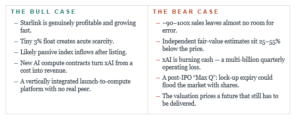
The case for owning it rests on scarcity, momentum, and a long-dated bet on AI infrastructure and space-based compute. The case against rests on arithmetic: by independent measures, the price already assumes a great deal of that future has been delivered, when much of it has not. Both things can be true at once – a phenomenal company and a demanding price.
For most long-term investors, the sober point is this: you rarely have to catch a SpaceX IPO on day one. Excitement and value tend to arrive on different timetables, and the period after lock-ups expire often tells you more than the opening print.
Whether any of this fits a particular portfolio depends entirely on individual circumstances, time horizon, and tolerance for risk. Understanding how a listing of this scale interacts with your existing wealth management strategy – and whether your current capital investing approach accounts for the index rebalancing dynamic SpaceX will trigger – is exactly the kind of review that pays dividends before the opening bell, not after.
Schedule a call →