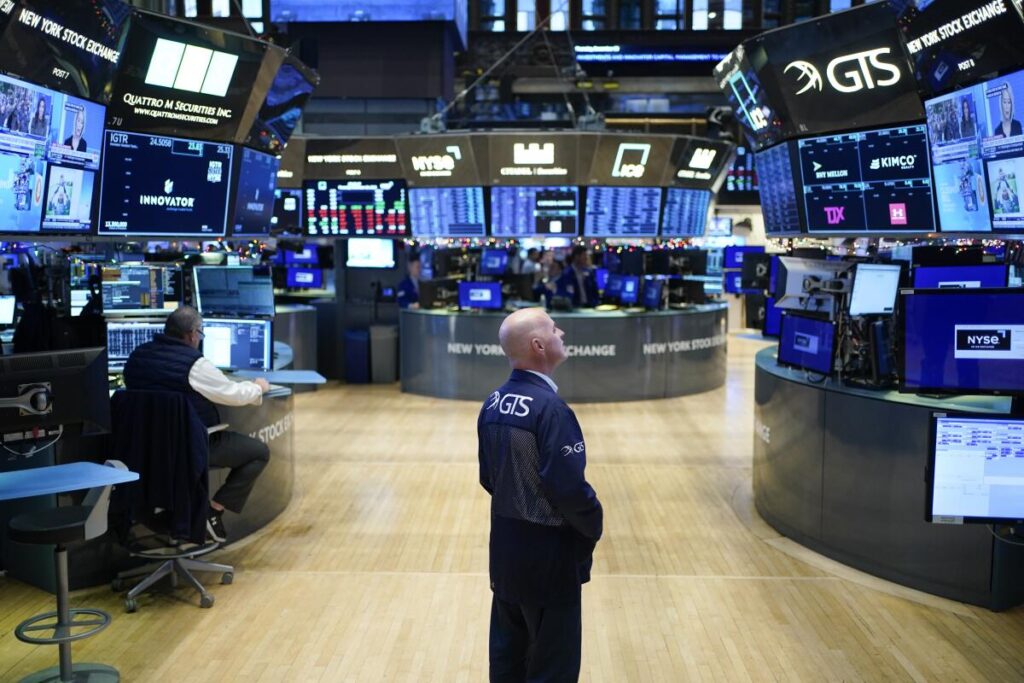
Equity markets have wobbled over the past several sessions, and the questions flooding in all rhyme: Is the bull market over? Is this another Dot-Com bust? Has the AI bubble finally burst?
Context matters more than ever right now, because the headline noise and the underlying data are telling two very different stories.
In this article, our team walks you through what is really driving the recent pullback in the S&P 500, the Nasdaq 100, and the SOXX semiconductor index, and why we remain constructively bullish.
Why Have the Markets Been Falling?
The recent pullback, in our view, is not the start of something structural. It is the convergence of three identifiable and largely temporary pressure points.
1. US Treasury Yields Are Spiking
The US 10-year Treasury yield touched 4.61% on 18 May 2026, its highest level in roughly a year, while the 30-year has pushed above 5.2%, a level not seen since 2007. Yields have climbed as elevated oil prices linked to the Iran conflict feed through to inflation, with US CPI hitting a three-year high in April and producer prices surprising sharply to the upside. Markets have now ruled out Fed rate cuts for 2026 entirely, and the implied probability of an additional 25bps hike before year-end has risen to around 40%.
This matters because the 10-year is the discount rate the market uses to value future cash flows. When yields rise meaningfully, long-duration assets, including most of the AI complex, compress mechanically.
“What we are seeing is gravity, not a verdict on the underlying businesses. When 10-year yields move from 4.2% to 4.6% in a few weeks, every long-duration cash flow on earth gets repriced. That is mathematics. It is not the market telling us the AI thesis is broken, it is the market resetting the discount rate.”
— Payal Trehan, Partner & Senior Investment Strategist
2. Crowded Positioning Met a Catalyst
After seven straight weekly gains in early May, sentiment had become one-sided. A modest move higher in yields was enough to trigger profit-taking, especially in the most crowded AI names. The Nasdaq has now posted back-to-back losses, with semiconductors leading the slide ahead of Nvidia’s earnings on Wednesday.
3. The Midterm Election Calendar
History tells us midterm election years routinely deliver intra-year drawdowns averaging around 18%, with corrections occurring roughly 70% of the time. We are simply paying our dues.
The Earnings Story: The Strongest Quarter in Four Years
Here is what almost no one is talking about while watching the tape: Q1 2026 has been one of the strongest earnings seasons in years.
With roughly 91% of the S&P 500 reported:
- Blended earnings growth: 27.7% year-over-year, the highest since Q4 2021
- 84% of companies beat EPS estimates, the highest beat rate since Q2 2021
- Aggregate earnings: 18.2% above estimates
- Net profit margin: 14.7%, a record going back to when FactSet began tracking the metric in 2009
Analysts now expect earnings growth of 19.9%, 23.2%, and 20.7% for Q2, Q3, and Q4 respectively, with full-year 2026 growth projected at 21.0%. Capex is rising 32% year-over-year, the fastest since 2007, and that capex is being funded out of cash flow, not debt.
“You do not get a market top when earnings are accelerating, margins are at record highs, and balance sheets are pristine. In 25 years of advising private clients across multiple cycles, I have learnt to separate what the screen is doing from what the businesses are doing. Right now, those two stories disagree-and the businesses are winning.”
— Michele Carby, Managing Partner – Wealth Management
Is This the Dot-Com Bubble All Over Again?
Our short answer: no.
In March 2000, the Nasdaq-100 traded at a forward P/E of roughly 60x. The four horsemen of that era, Microsoft, Cisco, Intel, and Oracle, traded at around 70 times two-year forward earnings. Around 74% of publicly traded internet companies had negative cash flows, with many projected to run out of money within a year. The dot-com bubble was, fundamentally, a solvency story dressed up as a technology story.
Today’s setup is materially different:
- S&P 500 forward P/E: 21.0x — above the 5-year average (19.9x) and 10-year average (18.9x), but a long way from dot-com extremes
- Hyperscalers (Mag 7) average two-year forward P/E: ~26x — roughly a third of where their 2000 counterparts sat
- Nvidia trailing P/E: ~46x — well below its own 5-year median of 61x
The dot-com bubble burst because earnings collapsed. In 2001, the tech leaders saw net income fall 65% year-over-year. Today, hyperscaler earnings are expected to grow 17% over the next 12 months, and the Magnificent 7 continues to outgrow the other 493 names in the S&P 500 by a wide margin.
“We respect the echoes, concentration is real, CAPE is elevated, the circular financing between Nvidia, OpenAI and the hyperscalers deserves scrutiny. But the foundational difference is simple: today’s AI leaders earn the money they spend. In 2000, they spent the money they hoped to earn. That single distinction changes the risk profile completely.”
— Payal Trehan, Partner & Senior Investment Strategist
Is the AI Bubble About to Burst? Nvidia Earnings Will Tell Us a Lot
Nvidia reports fiscal Q1 2027 earnings after the close on Wednesday, 20 May 2026. Consensus is for revenue of $79.2 billion (+79.5% year-over-year) and EPS of $1.78 (+120% year-over-year). Options markets are pricing an implied move of 10% or more around the print.
Our team will be watching:
- Data centre revenue growth — last quarter ran at +75% YoY
- Blackwell ramp commentary — Jensen Huang has spoken to $1 trillion of opportunity through 2027
- Gross margins — sustainability in the 75% range is the key tell on pricing power
- Forward guidance — any sign of demand normalisation or extended replacement cycles
A clean beat-and-raise from Nvidia would validate the entire AI capex thesis driving the index. A disappointment would amplify the bond-yield pressure and likely extend the current consolidation. The asymmetry around this print is real, and it arrives this week.
The Quality Story: The Real Story Behind the Headlines
Strip away the noise and you are left with this: the companies driving this market are the highest-quality businesses in the world by almost any metric.
Profit margins for the S&P 500 are at all-time highs. The hyperscalers are funding the largest corporate capex cycle in history out of operating cash flow, not debt. Their balance sheets carry investment-grade ratings. They generate consumer surplus measured in trillions. They are not Pets.com.
When yields rise, quality compresses too. But quality also recovers first, because the cash flows are real and durable. The rotation pressure may persist for a few more sessions. The underlying earnings power does not unwind.
This is why our investment approach has consistently emphasised quality as the anchor of equity allocations, owning businesses that compound through cycles rather than chasing names that only work in one regime.
The Most Important Lesson Investors Forget During a Selloff: Stay Invested
If we could put one piece of evidence in front of every investor during weeks like this, it would be this: the cost of missing the best days in the market.
According to JP Morgan Asset Management, an investor who put $10,000 into the S&P 500 in 2004 and simply stayed fully invested through today would have over $70,000. Miss just the 10 best trading days over those two decades, and that number drops to under $35,000, roughly half. Miss the 20 best days, and the annualised return falls from 10.5% to 3.6%. Miss the 30 best days, and your return drops to 1.4%, below cash.
Wells Fargo Investment Institute did the same exercise over a 30-year window (July 1995 to June 2025). Missing the best 30 days took the annualised return from 8.4% down to 2.1%, below the average inflation rate over the period. Miss the best 50 days, and the long-run annualised return goes negative.
Why? Because the best days do not announce themselves, and they cluster right next to the worst ones:
- 7 of the 10 best market days over the past 20 years occurred within just 15 days of the 10 worst days
- During the 2008 financial crisis, 7 of the decade’s 10 best days landed inside the worst six months of the drawdown
- In March 2020, three of the 30 best days and five of the 30 worst days happened in the same eight trading sessions
- 76% of the stock market’s best days have occurred during a bear market or in the first two months of a new bull market, exactly the moments investors are most tempted to be in cash
“This is the conversation we have with every client during every selloff. For two decades, I have watched investors do real, irreversible damage to long-term wealth by stepping out of markets during weeks that felt exactly like this one. The cost of waiting is almost always greater than the benefit of timing. Compounding is the most powerful force in private wealth, and it only works if you are present for it.”
— Michele Carby, Managing Partner – Wealth Management
Continued Investment Through Volatility: The Compounding Advantage
Our view has long been that volatile periods are when continued investment does the most work. Disciplined dollar-cost averaging into quality at lower prices is one of the most powerful tools available to long-term investors, and it has consistently rewarded clients who stayed the course through 2008, 2020, and 2022.
A simple illustration: $10,000 compounding at 7% per annum becomes roughly $76,000 over 30 years, and over $150,000 over 40 years, with no additional contributions. The defining variable is not the timing, not the size of the initial investment, but the duration capital remains invested.
Investors who kept adding through the drawdowns of the last cycle are sitting on returns that those who waited “until things calmed down” will likely never catch up to. Our advice has been consistent for years and remains so today: stay invested, keep investing, and let time do its work.
Our View: Bullish, Diversified, Disciplined
We remain constructively bullish on the S&P 500, the Nasdaq 100, and the SOXX semiconductor index through the remainder of 2026 and into 2027. The earnings backdrop is the strongest it has been in four years, AI capex is broadening into measurable productivity gains, and valuations, while elevated, are nowhere near the speculative extremes that historically precede a regime-shift collapse.
That said, we do not put all our eggs in one basket. Reflecting the cross-border lives our expatriate clients lead, we continue to advocate a diversified and balanced approach across borders and across asset classes. International equities, quality fixed income, structured products, alternatives, and selective emerging market exposure all have a defined role alongside the core US growth allocation. You can read more about how we structure client portfolios here.
“Our investment philosophy has always been to stay in sync with markets rather than try to outsmart them. That means owning quality, holding diversification across geographies and asset classes, and above all, staying invested when the headlines get loudest. That is how our clients have compounded wealth through every market environment we have advised them through.”
— Payal Trehan, Partner & Senior Investment Strategist
Let Us Talk
Periods like this one, volatile, headline-driven, emotionally challenging, are precisely when the value of a long-term wealth management partner becomes clearest.
If you would like to discuss how your portfolio is positioned for the current environment, or how a structured, cross-border, cross-asset wealth strategy can help you compound wealth through the next decade, our team is here to help.
We offer a complimentary 30-minute consultation in which we review your current financial position, your existing investment portfolio, and identify practical steps to strengthen your long-term wealth strategy as a global expatriate.
This article is provided for informational purposes only and reflects the views of The Michele Carby Practice as at May 2026. It does not constitute investment advice or a recommendation to buy or sell any specific security. Market views expressed are subject to change. Past performance is not indicative of future results. Investors should consider their own circumstances and consult a qualified professional before making investment decisions. The Michele Carby Practice operates as an autonomous partnership under the Holborn Assets Group.